When we are students, we often think that school is about getting good grades, passing exams, and eventually earning a diploma. It is only years after we leave that we begin to realize that the greatest inheritance education gives us is not a certificate hanging on a wall, but a way of thinking that stays with us for life.
I graduated from SMA Muhammadiyah 18 Cidodol in South Jakarta in 2009. More than fifteen years have passed since then. The world has changed. Technology has changed. Life has taken me through experiences I could never have imagined as a teenager sitting in a classroom. Yet something has remained constant: the lessons from the teachers who helped shape the way I see religion, society, and life itself.
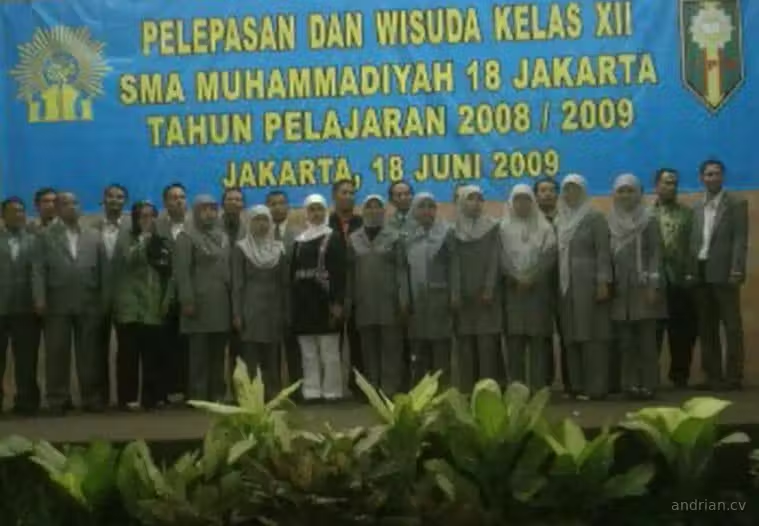
The teachers and staff of SMA Muhammadiyah 18 Jakarta at the send-off and graduation ceremony for Grade 12, school year 2008/2009.
When I look back on my high school years, I do not primarily remember classrooms, school fields, or exam preparations. What I remember most are the people who were there during a formative period of my life. They were teachers who did far more than teach subjects. They helped shape the lens through which I would eventually understand the world.
Socrates once suggested that education is not the filling of a vessel, but the kindling of a flame. I did not fully understand that idea until much later in life. The teachers who influenced me the most were not necessarily those who taught me the most facts, but those who ignited ways of thinking that continue to guide me today.
One of those teachers was Mr. Ahmad Jahid, my Islamic studies teacher. Through him, I learned that religion is more than a collection of rules, obligations, and rituals. He taught that faith also speaks about wisdom, compassion, and the ability to live alongside people who may think differently from us.
As a teenager, it is easy to see the world in black and white. Mr. Ahmad Jahid showed us that life is far more nuanced than that. He demonstrated that being a committed Muslim does not require closing one’s mind to different perspectives. Faith does not have to create fear of differences. Knowledge and religion are not enemies competing for authority; they can coexist and enrich one another.
Even today, whenever I meet people from different backgrounds, beliefs, and worldviews, I often realize that part of my ability to appreciate those differences comes from lessons I learned in his classroom many years ago.
Another teacher who left a lasting impact on me was Mrs. Munawaroh, my history teacher. Officially, she taught history. In reality, she taught something much larger.
Through her lessons, I learned that history is not simply a record of past events. It is a study of how people make decisions, build civilizations, navigate conflicts, and create change. More importantly, she constantly encouraged students to participate in organizations and take active roles beyond the classroom.
She believed that education should not be confined to textbooks and examinations. Students also need to learn how to lead, collaborate, communicate ideas, and take responsibility for the communities around them.
Her encouragement gave many students, including myself, the confidence to step beyond our comfort zones. At the time, I did not fully understand how valuable those experiences would become. Looking back now, I realize that many of the skills I rely on in business, technology, and leadership were first developed through the organizational experiences she encouraged us to pursue.
Then there was Mr. Mahfudz, who introduced me to the wider world of organizations and community movements beyond the school environment.
From him, I learned that society itself is a classroom. Organizations are not merely places where people gather or hold meetings. They are spaces where individuals learn to understand others, navigate disagreements, build trust, and turn ideas into action.
Through the activities he introduced me to, I began to understand that meaningful change does not always come from positions of power or authority. More often, it begins with ordinary people who care enough to act and courageous enough to persist.

Me and my classmates at the send-off and graduation ceremony for Grade 12 of SMA Muhammadiyah 18 Jakarta, school year 2008/2009.
As I grew older and became involved in business and technology, I frequently found myself drawing upon lessons that originated from those organizational experiences. The ability to build teams, listen to different perspectives, resolve conflicts, and maintain commitments did not appear overnight. Their roots can be traced back to lessons learned long before I entered the professional world.
The older I become, the more convinced I am that the true influence of a teacher cannot be measured through grades or academic achievements alone. Their impact often reveals itself years later, when former students begin building lives of their own.
Mr. Ahmad Jahid helped shape a more open and moderate understanding of Islam. Mrs. Munawaroh nurtured leadership, confidence, and a spirit of organization. Mr. Mahfudz introduced me to civic engagement and the importance of participating in society beyond the boundaries of school.
Perhaps they simply saw these efforts as part of their responsibility as educators. Yet for a student, an idea planted at the right moment can alter the direction of an entire life.
Today, I understand that a part of who we are is made up of the people who taught us, guided us, and believed in us. Education, therefore, is more than the transfer of knowledge. It is the passing of ways of thinking from one generation to the next.
If there is a legacy I still carry from SMA Muhammadiyah 18 Cidodol, it is not a report card, a diploma, or a collection of memorized lessons. It is a way of seeing the world.
To Mr. Ahmad Jahid, Mrs. Munawaroh, and Mr. Mahfudz, thank you. Time has passed, but the lessons you planted continue to live on in the decisions I make, the principles I hold, and the way I understand life.
Perhaps that is the truest measure of a teacher’s success: when their lessons continue to live long after their students have left the classroom.